![Motorcycle Fork Stem Phone Mount [Vibration Dampener] [Anti-Shake] One-Handed Operation Motorcycle Cell Phone Holder, Fit 12mm-25.4mm Diameter Fork Stem Tube, for 5.4″-7.2″ Smartphone](https://m.media-amazon.com/images/I/71nkWVMNuTL._AC_SL1500_.jpg "Motorcycle Fork Stem Phone Mount [Vibration Dampener] [Anti-Shake] One-Handed Operation Motorcycle Cell Phone Holder, Fit 12mm-25.4mm Diameter Fork Stem Tube, for 5.4″-7.2″ Smartphone")




Price:
(as of Mar 18, 2026 00:02:52 UTC – Details)

A Sturdy Solution for the Modern Rider: An In-Depth Look at the VAZESWIN Fork Stem Phone Mount
For the motorcyclist who relies on their smartphone for navigation, communication, or entertainment, the eternal quest is for a mount that is both supremely secure and incredibly convenient. The handlebar is the traditional domain, but it often introduces significant vibration, obstructs controls, and can leave the phone exposed to the elements and accidental impacts. Enter the fork stem mount: a clever alternative that relocates the device to a more stable, central position. The VAZESWIN Motorcycle Fork Stem Phone Mount, with its integrated vibration dampener and focus on one-handed operation, presents itself as a serious contender in this niche. This review dissects its design, features, and practical application based solely on its specified engineering and capabilities.
Design and Build: Engineered for the Fork Stem
The core innovation of this mount is its fundamental placement. Instead of clamping to the handlebar, it attaches directly to the motorcycle’s fork stem tube—the vertical column connecting the handlebars to the front wheel. This location is inherently more rigid than the handlebars, which move with steering and suspension, promising a markedly more stable platform.
The main body is constructed from a “high-strength composite material,” a specification that suggests a balance between lightweight construction and robust impact resistance. The phone-cradling mechanism utilizes eight silicone claws. This multi-point contact design is pivotal; it distributes clamping force evenly across the phone’s edges and corners, minimizing pressure points that could potentially damage a case or device over time. The inclusion of a “1” ball double socket arm” is a standard and highly versatile feature in the mounting world. This ball joint allows for infinite articulation, enabling the rider to position the phone at the perfect viewing angle before locking it in place.
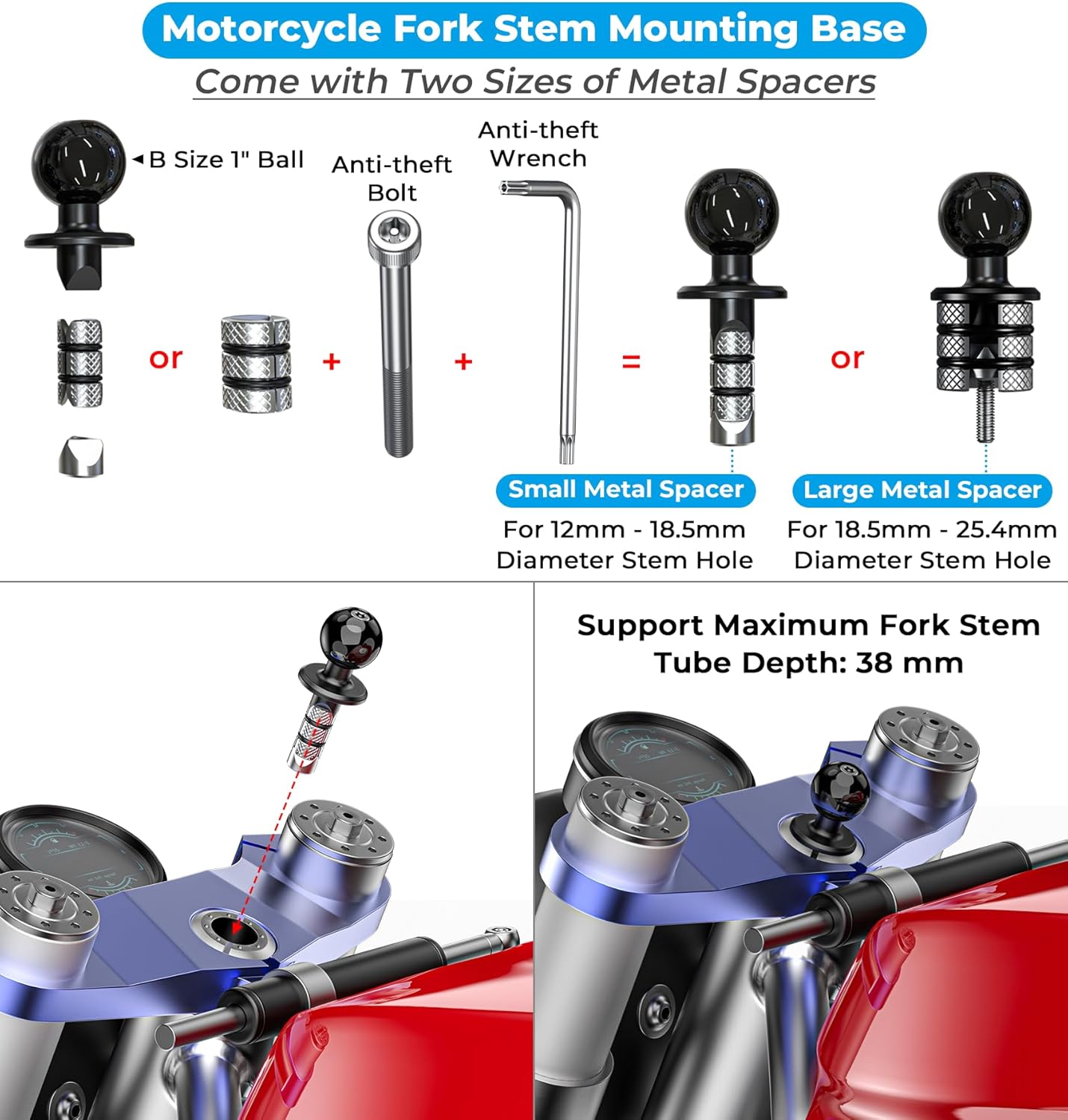
The mounting base is specifically engineered for the fork stem. It’s a metal component designed to fit either cylindrical or hexagonal bore walls, accommodating the varied geometries of different motorcycle forks. The package includes two metal expansion spacers—one small (12mm-18.5mm) and one large (18.5mm-25.4mm). This is a critical inclusion, as fork stem diameters vary widely across bike models. By selecting the appropriate spacer, the mount achieves a tight, customized fit on any stem tube within the 12mm to 25.4mm (approximately 0.47″ to 1″) range. The specification that the metal base supports a minimum tube depth of 38mm is a key installation detail, ensuring there’s enough stem length for a secure anchor.
The Heart of the Matter: Vibration Dampening and Camera Protection
This is the mount’s primary marketed advantage and its most technically interesting feature. The product description explicitly states it includes a “vibration dampener” designed to “minimize the shock and shake to your phone & phone camera while riding.” High-frequency vibrations from the engine and road surface are the sworn enemy of phone cameras, often leading to blurred photos, potentially damaged image sensors, and general instability in navigation apps.
The mechanism here is described as a “non-contact design” for the phone and its camera. This suggests the dampener is integrated into the mount’s arms or junction points, likely using rubberized bushings or elastomeric elements within the ball socket system. Rather than the phone being rigidly clamped to a vibrating metal arm, these dampening materials absorb and dissipate kinetic energy before it reaches the device. This is a significant upgrade over basic, all-metal clamp mounts that simply transmit every engine buzz and road imperfection directly to the phone. For the rider who takes photos or videos from the bike, or for anyone who’s watched their navigation screen jiggle uselessly on a rough road, this feature alone could be a deciding factor.
Furthermore, by preventing direct physical contact between the mount’s hard parts and the phone’s camera module, the risk of scratches, pressure points, or misalignment from prolonged clamping force is notably reduced. It’s a thoughtful touch that addresses a common, if often overlooked, pain point.
Usability: Truly One-Handed?
The claim of “One-Handed Operation” and “1 second to put in or take out the cell phone” sets a high bar. This is achieved through a quick-release mechanism, likely a lever or asymmetric clamp design. In theory, a rider, while stopped or even at a very slow roll, should be able to secure or release their phone with a single hand and minimal effort. The mount also boasts 720 degrees of rotation (a full two rotations), meaning it can be oriented in virtually any plane—horizontal for landscape navigation, vertical for portrait apps—without tools.
This ease of use is paramount for safety. Fumbling with complicated latches or multi-step locking mechanisms while wearing gloves or in a hurry is a liability. A truly intuitive, one-motion securement system allows the rider to keep their primary focus on the road and their other hand on the controls. The requirement to adjust the cradle width via bottom screws for different phone sizes is a one-time setup, after which the phone should slide in and lock with that promised single motion. The stated compatibility range is quite generous: phones (with case) from 135mm to 174.5mm in length, 62mm to 93mm in width, and up to 16mm thick, covering screen diagonals from 5.5″ to 7.2″. This encompasses nearly all modern flagship and mid-range smartphones, even with bulky protective cases.
Installation and Compatibility: The Critical First Step
Installation is a make-or-break moment for any stem mount. The process is clearly defined: measure the fork stem diameter, select the correct expansion spacer, and install the metal base. The reliance on an expansion fit means it requires a solid, positive insertion onto the stem. The 38mm minimum depth requirement means this mount is not suitable for bikes with very short or recessed stems. Potential buyers must measure their stem’s exposed length before purchasing.
Once the base is secure, the double-socket arm attaches, and the phone cradle is connected. The entire assembly is then positioned and angle-adjusted before tightening the socket locks. The instructions (implied by the step-by-step description) seem straightforward, but success depends on having the correct tools (likely an Allen key) and a clean, debris-free stem surface. The mount’s strength is only as good as its installation—an improperly seated base on an incorrectly sized spacer will lead to movement and potential danger.
Real-World Considerations and Potential Drawbacks
While the specification sheet is impressive, a few points warrant consideration:
- Stem Depth Requirement: The 38mm (1.5″) minimum stem depth is non-negotiable. This excludes some sportbikes, adventure bikes with short stems, or custom setups where the stem is mostly housed within the triple clamps.
- Exposure to the Elements: Unlike a handlebar mount that can sometimes be angled away, a stem mount places the phone directly in the path of wind, rain, and road spray. While the mount itself may be durable, the phone’s vulnerability increases. This is not a flaw of the mount, but a characteristic of the stem-mount location that users must accept.
- Potential for Interference: On some motorcycle models, a stem-mounted phone could interfere with the lice (the cable that connects the front brake lever to the master cylinder) or the inner fairing when turning the handlebars to full lock. Riders must check for clearance at full steering lock in both directions.
- Security Lock: The product description table indicates that some variants in the VAZESWIN series have a “Security Lock” feature, while others do not. It’s crucial to verify which specific listing you are purchasing. A secondary locking mechanism (like a small pin or additional latch) provides peace of mind against accidental release from severe bumps or vibration.
Final Verdict: A Niche Specialist Done Right
The VAZESWIN Fork Stem Phone Mount is not a universal solution, but for the subset of motorcycles it fits, it appears to be a meticulously engineered tool. Its success hinges on three pillars: location (the stable fork stem), technology (the vibration dampener and non-contact camera design), and ergonomics (the claimed one-handed operation).
For the rider whose bike has a suitable stem, who values a rock-solid view of their screen over absolute weather protection, and who prioritizes quick, glove-friendly access to their device, this mount makes a compelling case. It directly attacks the two biggest complaints of traditional handlebar mounts—vibration and awkward placement—with thoughtful, specified solutions. The variable compatibility via expansion spacers shows an understanding of motorcycle diversity.
Ultimately, this product is a specialist’s tool. It promises less shake, better camera safety, and easier access by moving the phone to a smarter location. If your motorcycle’s anatomy allows for its installation, and your priority is a stable, reliable connection between you and your device on the move, the VAZESWIN fork stem mount deserves a close look. Its value is defined not by a one-size-fits-all approach, but by its focused excellence within its intended, specific application.