





Price:
(as of Mar 17, 2026 15:08:05 UTC – Details)

The GoorDik USB-C Wireless Lavalier Mic: A Portable Powerhouse for Modern Content Creators
In the ever-evolving landscape of content creation, audio quality can be the decisive factor between a professional-looking production and a forgettable clip. For vloggers, TikTokers, YouTubers, and podcasters recording on smartphones or tablets, the quest for clean, clear sound without cumbersome gear is constant. Enter the GoorDik USB-C Wireless Mini Lavalier Microphone—a system promising professional-grade audio capture in an ultra-portable, plug-and-play package. But does it deliver on its bold claims? After a thorough examination of its specifications and design philosophy, here is an in-depth, specification-based review.
Unboxing and First Impressions: Utility Meets Simplicity
The product arrives as a comprehensive kit. Inside, you find the core components: two wireless microphone transmitters (the actual lavalier mics), one receiver unit with a USB-C plug, a one-to-two charging cable, four foam mic covers, two furry windscreen “deadcat” muffs, a USB-C to USB-A adapter, a Lightning-to-USB-C adapter for older iPhones, and a user manual. This is not a minimalist, single-microphone system; it’s a true dual-channel wireless setup right out of the box. The inclusion of both a USB-A adapter and a Lightning adapter immediately signals GoorDik’s intent for universal compatibility, a majorplus for creators who may switch between Android, newer iPhones (iPhone 15’s USB-C), and even desktop computers.
The hardware itself feels lightweight and durable. The transmitters are small, rectangular clips with a built-in omnidirectional microphone capsule. The standout physical feature is the magnetic microphone clip on each transmitter. This is more than a simple clip; it allows for 360-degree rotation of the mic capsule. This means you can attach the transmitter to your collar or lapel and then freely pivot the mic to point directly toward your mouth, optimizing the omni-directional pickup pattern for your specific speaking position—a thoughtful design touch often missing in cheaper lavaliers.
Core Feature: Active Denoise Technology and Sound Capture
The headline feature is the “Active Denoise” technology. According to the specifications, the system employs dual noise reduction modes: a dedicated “Noise Reduction” mode and an “Original Sound” mode. This is a digital signal processing (DSP) feature, not just a physical windscreen. In “Noise Reduction” mode, the internal processor algorithms work to suppress consistent background hums—like air conditioning, computer fans, or traffic—aiming to isolate your vocal frequencies. The “Original Sound” mode bypasses this processing, providing a flat, uncolored frequency response preferred by some purists or for recording musical instruments.
The kit’s physical accessories support this audio clarity mission. The four foam mic covers protect the capsule from plosives (hard ‘P’ and ‘B’ sounds) and light wind. More critically for outdoor or mobile recording, the two furry windscreen muffs are substantial. They are designed to drastically reduce wind noise, a common nemesis of on-the-go vloggers. This combination of active digital noise reduction and robust passive wind protection is a robust two-pronged attack on audio impurities, positioning this mic as suitable for both controlled indoor environments and unpredictable outdoor shoots.
Wireless Performance and Battery Life: Freedom with Limits
The system operates on a 2.4GHz wireless connection, a standard for such devices, offering a stated 20-meter (≈65-foot) open-range distance. This is ample for most solo creator scenarios—walking around a room, filming in a large studio, or conducting an interview at a short distance. Reliability in crowded RF environments (like a convention center with hundreds of Wi-Fi networks and Bluetooth devices) isn’t specified, so urban or dense tech event shooters should be aware of potential interference, though 2.4GHz is generally resilient.
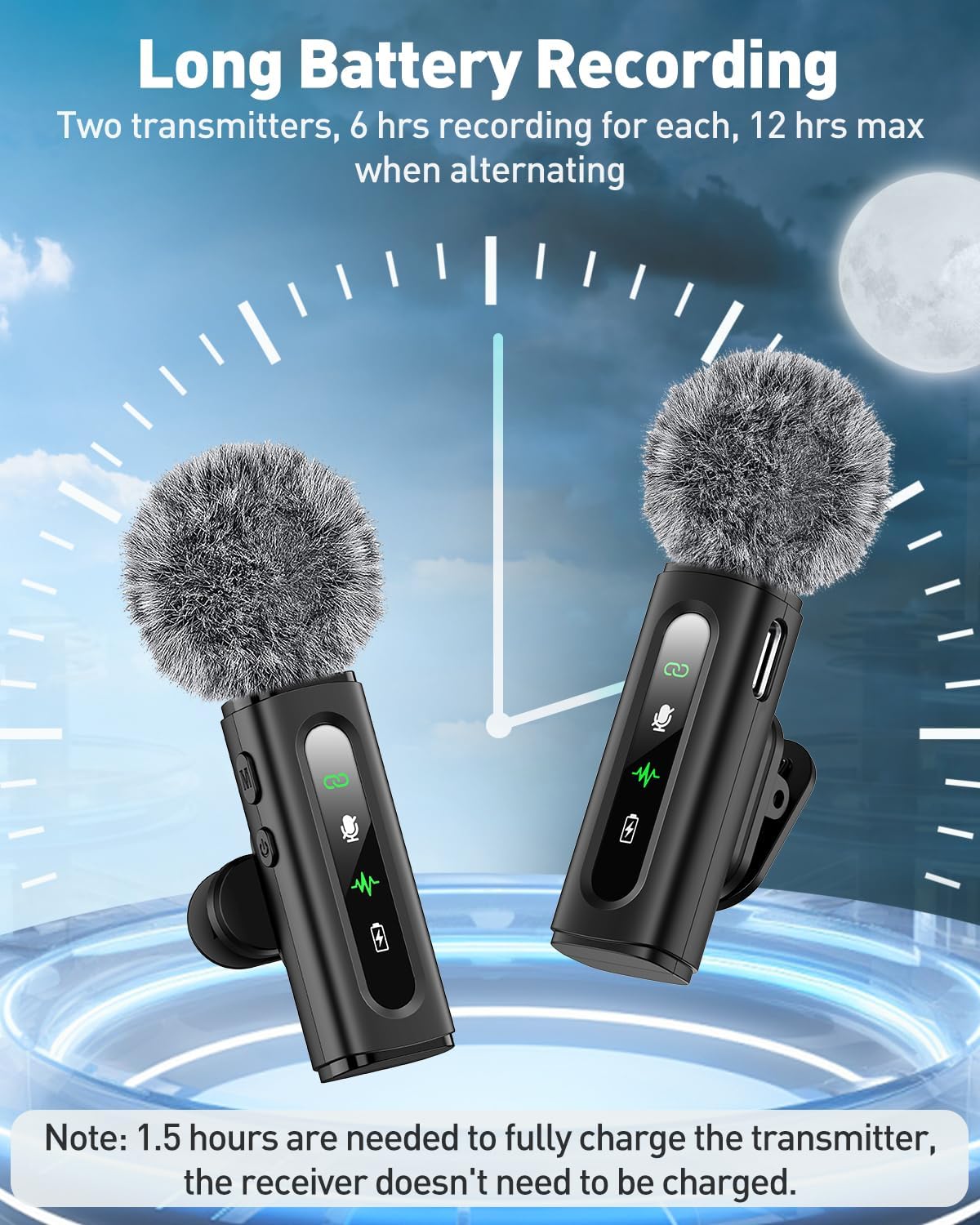
Battery life is a practical highlight. Each transmitter houses a 60mAh battery, delivering 6 hours of continuous recording on a single charge. The package includes a single USB-C cable that splits to charge both transmitters simultaneously. The key specification here is the note from the Q&A section: recording while charging the transmitter is not supported; the mic will turn off during charging to protect the battery. This is a common safeguard in small wireless devices but a crucial workflow consideration. For marathon recording sessions, you must plan charging breaks or have a power bank to charge the spare transmitter while one is in use. The receiver itself appears to be passively powered via the host device (your phone/tablet/PC), so it doesn’t have its own battery.
The receiver also includes a USB-C port for pass-through charging of your phone. This is a fantastic feature for long recording sessions, allowing you to keep your primary device powered without unplugging the microphone receiver. It effectively turns the receiver into a small power bank for your phone, ensuring your camera doesn’t die mid-take.
Compatibility and Ease of Use: “Plug & Play” in Practice
GoorDik markets this as a “Plug & Play” device, and the design supports this. The receiver is a simple USB-C dongle. For an Android phone or iPhone 15, you plug it directly in. For other iPhones, you use the included Lightning adapter. For computers, you use the USB-A adapter. The system is designed to be recognized as a standard USB audio input device by the operating system.
However, the product description includes a critical, non-negotiable caveat: some Android phones require manual OTG (On-The-Go) activation in settings. This is a standard Android security feature but can be a stumbling block for less tech-savvy users. Similarly, on computers, you must manually select the “GoorDik Mic” as the default audio input device in your system’s sound settings or within your recording/streaming software (OBS, Zoom, etc.). It’s not always automatic, but these are one-time setup steps.
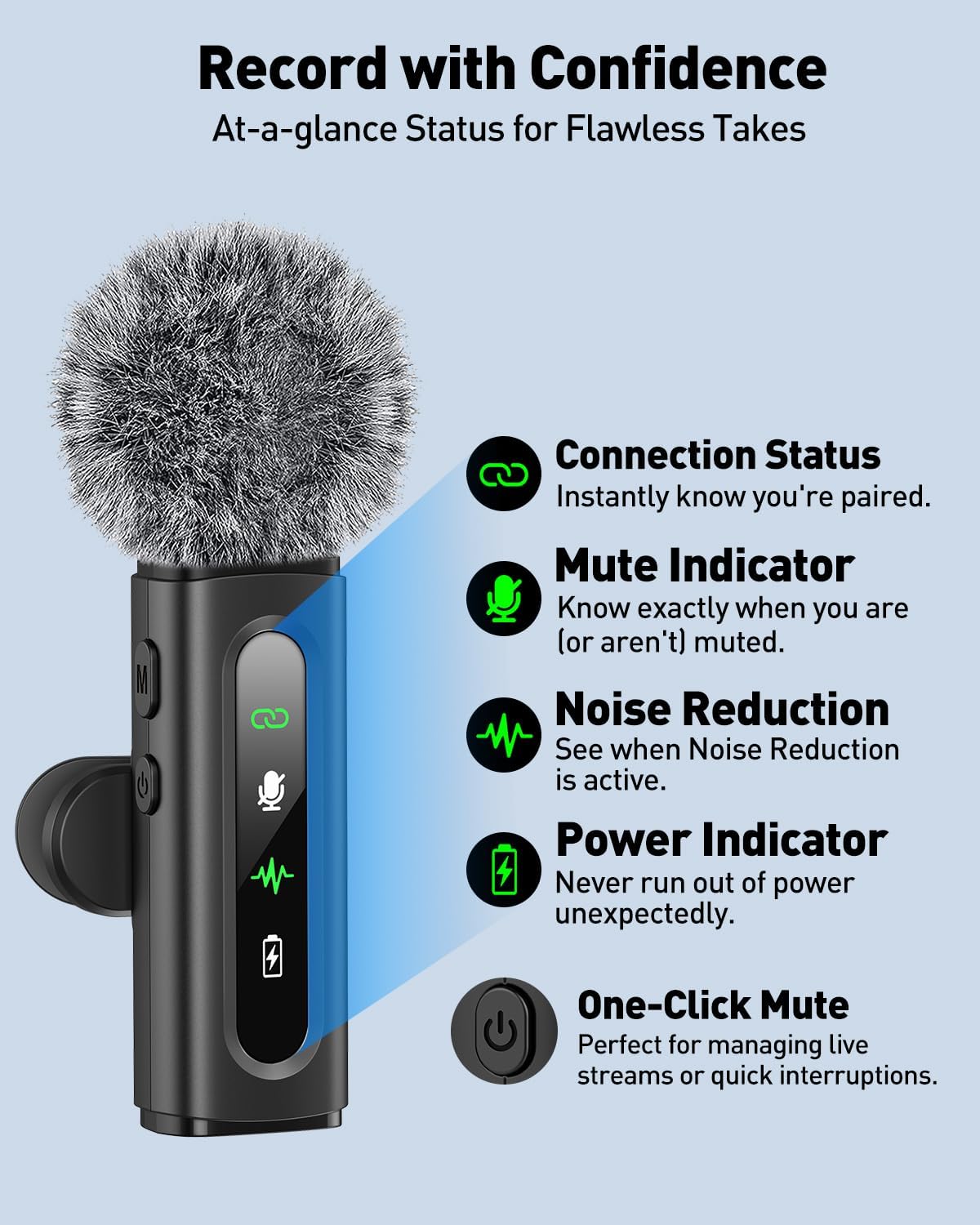
The user interface on the transmitter is intuitive, with indicator lights for power, pairing, noise reduction mode, and mute. Muting is handled directly on the transmitter, a vital function for in-the-moment control without touching your phone.
Target Audience and Use Cases
This microphone is explicitly engineered for:
- Mobile-First Creators: Vloggers, TikTokers, and Instagram Reels creators who primarily film on their smartphones. The USB-C/Lightning compatibility is perfect for this demographic.
- Beginner to Intermediate Podcasters: Those wanting a simpler, more portable setup than a full XLR interface. The dual-transmitter setup is excellent for interviews or co-hosted podcasts.
- YouTubers on a Budget: Anyone seeking a significant audio upgrade over a phone’s built-in mic or a cheap wired headset without breaking the bank.
- Educators and Remote Workers: For clear audio in online courses, Zoom meetings, or training videos where mobility and simplicity are key.
It is not designed for:
- Professional Studio Recording: While the sound will be clean, the character is optimized for speech, not detailed musical instrument capture.
- Users Needing Voice Amplification: The Q&A explicitly states it does not amplify your voice for live monitoring through the phone’s speaker; it is a recording device only.
- “Set and Forget” 12-Hour Recordings: The 6-hour per-transmitter limit (with use-and-charge cycles) means it’s not for single-day, unbroken event documentation without a power strategy.
Verdict: A Highly Competent Tool for the Job
Based solely on its described specifications and features, the GoorDik USB-C Wireless Lavalier Microphone System presents an exceptionally strong value proposition. Its strengths are comprehensive:
- True Dual-Channel System: Two transmitters in the base package is generous and immediately enables two-person content.
- Smart Physical Design: The rotatable magnetic clip is a standout usability feature that genuinely improves audio capture.
- Robust Noise Defense: The combination of active DSP denoise modes and two types of physical wind protection (foam and furry) shows an understanding of real-world recording challenges.
- Thoughtful Power Management: Phone pass-through charging is a masterstroke for mobile creators, and the 6-hour battery life is respectable for its class.
- Aggressive Compatibility: The inclusion of both USB-A and Lightning adapters future-proofs it for a wide array of devices.
The limitations are clear but industry-standard for this form factor: no charging while recording, the need for manual OTG/sound settings on some devices, and a 6-hour battery ceiling per unit.
Final Recommendation: For the content creator who records primarily on a smartphone or tablet and needs reliable, high-quality audio with the freedom of movement, this system is a compelling and seemingly well-executed solution. It addresses the core pain points of mobile audio—wind noise, background hum, awkward cables, and limited device compatibility—with a thoughtful, feature-packed kit. If the sound quality in real-world testing matches the promising specifications (active denoise efficacy, low self-noise, clear frequency response), this GoorDik system could easily become the go-to recommendation for aspiring and established creators seeking a wireless lavalier upgrade without studio-complexity. It appears to be a purpose-built tool that understands the workflow of the modern, mobile content creator.